
FITs & Groups Explained
What is the difference between the FITs and Groups applications?
The table below identifies the main differences in functionality within each booking application (i.e. FITs and Groups)
| Functionality | FITs Application | GROUPS Application |
|---|---|---|
| Pax configuration (Rooming Lists) | Required to insert pax name by pax name and room by room. | Able to insert all rooms at once. |
| Pax configuration (Escort, Driver, Guide) | Unable to insert Escorts, Drivers, or Guides. | Able to insert Escort, Drivers and Guides. |
| Pax configuration (Name List) | Required to insert name one by one or from Pax CRM. | Can be imported with Excel. |
| Itinerary | Limited to one itinerary. | Able to have multiple itineraries with different pax numbers. |
| Service adjustment (Pricing) | Able to adjust on a room by room basis. | Only able to adjust all of the same room types at once. |
| Service adjustment (FOC) | Not able to give FOCs. | Able to adjust FOCs. |
| Service adjustment (Markup/Commission) | Adjustable based on a per service / booking basis. | Adjustable based on a room type / service basis. |
| Accounting (Invoicing) | Only able to invoice by booking. |
Able to invoice by itinerary. Able to invoice per room. |
| Online Distribution | Available | Unavailable |
Tourplan NX makes no judgement as to what the difference is between an FIT and a Group Booking; i.e. when should FITs be used and when should Groups be used. Passenger numbers do not enter into it - the only rule that needs to be observed is that FITs ignores any references in the Product Database to Escorts, Drivers and Guides, so if a booking being handled has any of those elements in it, then Groups must be used.
Further Understanding
General guidelines are: FITs bookings are used when the room configuration, occupancy, and guest details are known at the time of booking, allowing rooms to be created and priced accurately from the outset.
In contrast, a Group booking is intended for situations where expected number, mix of passengers (adults, children, and infants) and indicative room types are known initially, enabling pricing to be built around projected requirements. Group bookings also support multiple itineraries within the same booking, allow for additional costing components such as drivers, escorts, or guides, and can accommodate FOC (free of charge) passengers or rooms within the overall structure. A detailed rooming list, including final guest names and exact room configurations, is then added closer to travel.
Lets take a closer look at the room/pax configuration differences between FITs and Groups.
FITs
In Tourplan NX, there are some rules relating to Pax Configurations for FIT bookings and Quotes:
-
The configuration must exist before it can be used.
This may sound completely logical, but the system needs to know what the Room Configuration is before services that can cater for it are able to be located in the Product Database. For example if the booking has a basic configuration of 4 adults in 2 doubles and for one accommodation service a two bedroom apartment is required, NX will find the apartment service and room services that accommodate 4 pax either 2 double rooms or an apartment service.
-
Configurations are bound to services.
The same configuration can be used and bound to more than one service.
-
Pax names provide the best outcome for Configurations.
Pax names are not mandatory, and if not used, internally a name record is created for each passenger. So if a booking is created for Brown/Smith Party, 4 adults in two doubles and no individual pax names entered, the itinerary scroll (displaying who is having which services) will show something like Brown/Smith Party/1, Brown/Smith Party/2, Brown/Smith Party/3 and Brown/Smith Party/4.
When individual pax names are used, the pax names are displayed against their services.
-
Names are bound to configurations.
This rule applies to all services, but is more relevant to pax based services than room based services. Pax Names are attached to configurations, so a configuration for the transfer which had three pax on it – e.g., Mr Smith, Mrs Smith and Mrs Brown would be a ‘3 Adults’ configuration. If, for a different service, three different pax were involved – e.g., Mr Smith didn’t want a sightseeing tour – then a new ‘3 adult’ configuration will need to be set up for Mrs Smith, Mr Brown & Mrs Brown.
- If all pax are having all services, no additional configurations will be needed.
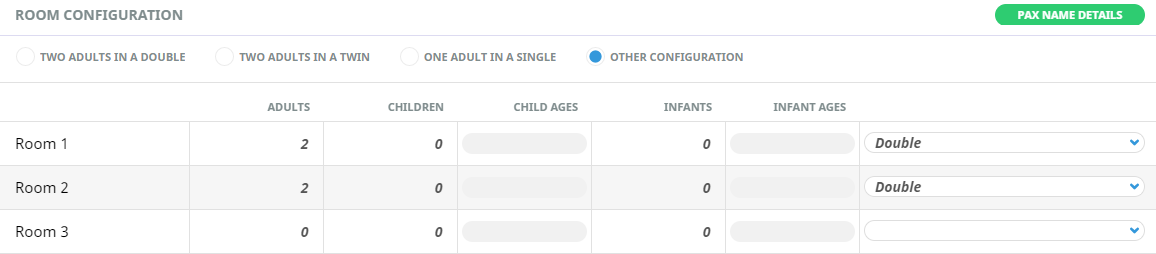
Example 1: Four adults in two double rooms
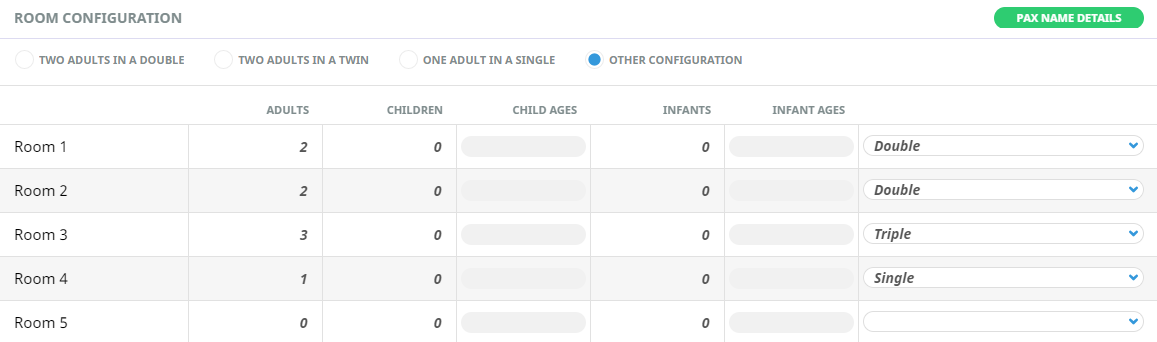
Example 2: Eight adults in two doubles, one triple and one single
Groups
Group bookings, the number and type of pax are the lead detail.
Pax names are generally not known when the booking is created, so it can be created with the expected number and type of pax (Adults, Children, Infants) and rooms (Singles, Twins, Doubles etc). The services are added and the costs calculated before pax names need to be entered and it is the Pax Configuration screen where pax details, once known, are entered.
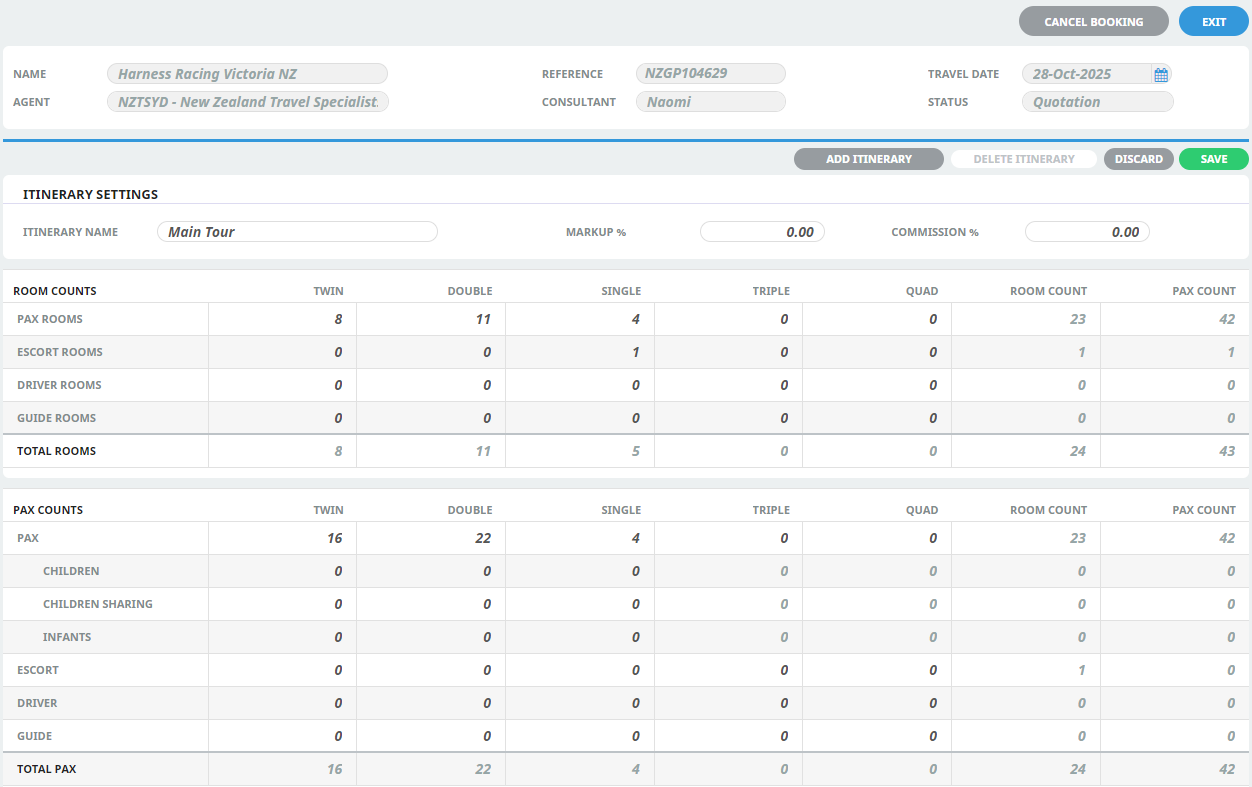
Pax Configurations enables the number and type of pax (adults, children and infants) plus the room configuration to be entered. This information is used by Tourplan NX to automatically cost and price the services that are subsequently added to the booking.
NOTE: Only pax types and room quantities are required for costing purposes; individual passenger names can be added later via the Rooming List option.
NOTE: Most bookings require only one itinerary, however, you can add multiple itineraries if required (see Add an Itinerary in Working with Itinerary).
Conclusion
In summary, use an FIT booking when you have confirmed room configurations, exact occupancy, and full guest details ready to be priced immediately. Use a Group booking when you are working with estimated passenger numbers, need flexible rooming to be finalised later, require multiple itineraries, or need to include additional costing elements such as guides, escorts, drivers, or FOC passengers and rooms.